Yellow Aster Butte


Labels: film cameras, photos
posted at 11:50 PM


| “I know where I'm headed.” |
| ROGER THORNHILL |
 I'm wondering if I should blow this up five or six feet wide for my office wall. That might be kind of cool. Things are always changing, but I doubt a digital file produced by anything less expensive than a car could withstand that kind of enlargement. Also, you couldn't take this shot with digital in the first place. Correction: you could. The camera costs $42,000.
Labels: film cameras, photos
posted at 1:13 AM

Labels: expeditions, film cameras, photography, photos
posted at 2:38 PM
hey bill,
Yes i'm aware the camera must be perfectly level for straight horizons :) but i'm just wondering how much i can angle my camera down (so the horizon will be above halfway) with the lense shifted BEFORE that starts taking place, get me?
Labels: film cameras, mocking others, photography

posted at 4:32 PM
Labels: film cameras, photography
posted at 12:11 AM

Labels: film cameras, photography
posted at 9:10 PM

Labels: film cameras, photos
posted at 7:13 PM

I think you need a more detailed analysis on your blog about exactly what you think is going to happen with the digital photos. Currently JPEG is probably the most common format in the world. One can assume that 100s of millions are taken daily. You don't think that format will be supported in 20 years? I think you're crazy. At the bare minimum, there will be common and free programs to convert
your existing JPEGs to whatever format is prevalent at that time. But I've been doing computer graphics stuff since 1993 . . . (14 years ago!! Close to 20!) and all the formats that existed then exist now—PSD, TIFF, PICT, EPS, etc. Even the unusual formats can be converted with specialized software like Debabelizer. Program files (WP, Quark) may get harder and harder to open if you don't keep them updated. But standard file formats, I don't see an issue.
50 years—maybe.
And of course, if the files are lost, destroyed, deleted, etc. But of course that can happen with anything in life, including prints and negatives, which can go bad as well and usually only exist as one copy.
 The following is a version of my response to him.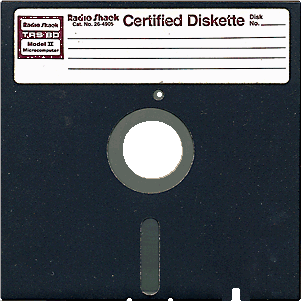
 It's true that "one-copy" physical media don't always last, and are vulnerable to various (individually very improbable) catastrophes. You could come up with an annualized rate at which this could be expected to happen. It is a rate that is not too much affected by lack of specific human attention. In 20 years, most of the film sitting in the backs of closets will still be fine. Any digital files stored that way will be unavailable (someone could "back out" an imputed annualized rate of decay for digital files left sitting unattended, which would interesting to see). In terms of other stuff you have around the house, film is more like a book and digital is more like a houseplant. You can keep the houseplant alive for a long time, and if you propagate it right maybe it will live forever. But the book just sits there and is fine for a long time with no attention. And how many of our grandparents' houseplants do we have? This is not a perfect comparison, to be sure, but interesting to think about.
Digital Data Archiving Gets Neglected
In business as in private life the long-term storage is neglected. Documents of considerable historical and sociological importance will be lost. Even in professional archiving institutions the digital archives all have a astonishingly short 'shelf-life'.
It becomes necessary after 10-15 years to transfer the entire digital archive from one storage system to another with increasing costs.
Digital Media with an Expiry Date
Digital storage media age and at a much faster rate than analog ones. CD-ROMs have been and still are one of the most popular storage media, yet they are among the least durable media we have. Egyptian papyrus or documents of medieval Europe survived for centuries.
Missing Storage Systems and Computers
Storage media develops as fast as processors. The replacement of computer generations is significant in a number of ways:
- when a system vanishes, data formats are lost
- when a system vanishes, connections and system buses are lost
- whenever a new system comes onto the market, this increases the pressure for change and the elimination of older systems.
Digital File Formats That Everyone Has Forgotten
Not only the physical durability of the media themselves and the usability of the storage media is limited, but also the file formats used for the information also change roughly every ten years.
Practically speaking, this means that every ten years when the inevitable transfer of data takes place, a certain proportion of the data won't be converted and in time will become unusable. This is of course the very opposite of what archives, museums and libraries were established for in the first place.
The loss is already considerable. You may have noticed that any files you carefully recorded on 5l/4" floppy disks a few years ago are now unreadable. Not only have those disk drives disappeared, but so have the programs, operating systems, and machines that wrote the files (WordStar in CP/M on a Kaypro?). Your files may be intact, but they are as unrecoverable as if they never existed. The same is true of Landsat satellite data from the 1960s and early 1970s on countless reels of now-unreadable magnetic tape. All of the early pioneer computer work at labs such as MIT Artificial Intelligence is similarly lost, no matter how carefully it was recorded at the time. The pioneer work of today is just as doomed, because the rate of digital obsolescence keeps accelerating, and the serious search for a long-term strategy for storage has yet to begin.
Labels: film cameras, if only they would listen to MWR, parenting, photography, scenes from my outbox
posted at 1:58 PM

Labels: film cameras, if only they would listen to MWR, parenting
posted at 1:56 PM
Labels: film cameras, irony, Only in Don't Trust Snakes, what passes for introspection
posted at 11:01 PM
 I make no great artistic claim here, nor am I saying no digital camera could take a photo like this (the Canon 5D with the 85/1.2 would do nicely). Still, I think this is a far cry from the kind of point-and-shoot digicam shots most parents generate exclusively these days. Even those who don't mind (or just don't know to mind) those flash-bathed, everything-in-focus images from the ubiquitous PowerShots and Coolpixes will be disappointed in twenty years when, for any number of reasons, they don't have access to most of their photos. This web forum post is an interesting read. The author is a very well established professional photographer.
Labels: film cameras, photography, photos
posted at 5:57 PM

Labels: film cameras, photography
posted at 12:13 PM

Labels: film cameras, photography
posted at 12:15 AM

Rendering of black synthetic fibersMakes it pretty hard to photograph people when certain black clothing comes out purple. Check it out. Adding a filter in front of some of the finest lenses ever made is not an attractive option.
The elimination of color fringing and the improvement of image resolution results in higher IR sensitivity. This causes some synthetic textiles to appear an artificial-looking purple.
If the higher IR sensitivity has a disturbing effect in certain applications, e.g. fashion photography, LEICA Camera AG offers its customers a special IR barrier filter. This is screwed on in front of the lens and is an ideal combination of IR, UV and protection filter. - Official Leica Statement regarding the M8
Due to the high spiritual purity of the Ark, users may experience facial melting. If the high spiritual purity has a disturbing effect in certain applications, e.g. world domination, Lost Ark AG offers its customers special blindfolds.
Labels: film cameras, photography
posted at 12:09 AM
Kodak Introduces Enhanced PORTRA Color Negative Films with Finer Grain, Spectacular Skin Tones, Vivid Color and Ideal Scanning PerformanceOh, but film is dead. I forgot. That's probably why, after the new Portra 160NC is introduced, three of my four most-used films will have come on the market as new or reformulated emulsions within the preceding three years (160NC, Fuji Pro 400H and Fuji Astia 100F).
ROCHESTER, N.Y.--(BUSINESS WIRE)--Sept. 11, 2006--
Continued Innovation Gives Pro Photographers High Quality Films to Achieve Impactful Images
In a move that underscores its ongoing support of the professional photography market, Eastman Kodak Company today introduced enhanced versions of its iconic KODAK PROFESSIONAL PORTRA color negative film family, comprising 160 VC, 160 NC, 400 VC and 400 NC film. These films help professional photographers create stunning images with finer grain, spectacular skin tones, and improved scanning performance for greater enlargement capability. Plus, PORTRA 160VC and PORTRA 400VC films now provide a more ideal combination of higher color saturation and lower contrast for optimal performance in high-color applications. - Kodak Press Release
Labels: film cameras, photography
posted at 12:52 AM
 Well, perhaps not. But I did manage to draw you in to this diffuse collection of further photography musings, to wit . . . . White balance is one area where color digital has a clear advantage over color film, especially with the proliferation of different types of non-tungsten artificial lighting. With color film, you always need to be aware of the differences in color temperature of outdoor vs. indoor light. For this reason, I almost always use black and white film if I know I'll be shooting indoors. I could get a color film balanced for tungsten light or--these days--scan the film and correct the color after the fact using Photoshop, but it's easier just to use black and white. As sensors get better at high-ISO performance, digital should be great for low-light photography. I'm partial to a full-size sensor so lenses will behave as they do in 35mm film photography--notably, so not everything is in focus.
 I've seen some amazing examples shot with a Canon 5D - 85mm f/1.2 combo, but that's $2K for the lens and $3K for a the body that, unlike certain film cameras, won't be state-of-the-art in its class indefinitely. The 5D is a real SLR with a real optical finder, but it's not a finder that's designed for manual focusing. So I'm not sure how useful it would be focusing an 85/1.2 critically, since that lens has razor-thin depth of field close up at full aperture. But if you could crank the ISO high enough without excessive "noise", you wouldn't need a fast prime lens at all. Fuji just released a digicam, the F30, I think, that supposedly has amazing performance even at ISO 3200 (but no optical viewfinder at all). It also has a mode where it will take a flashless photos and a flash photo within milliseconds of each other on the same press of the shutter. That's a clever way to show people that they don't need the flash for every shot.
 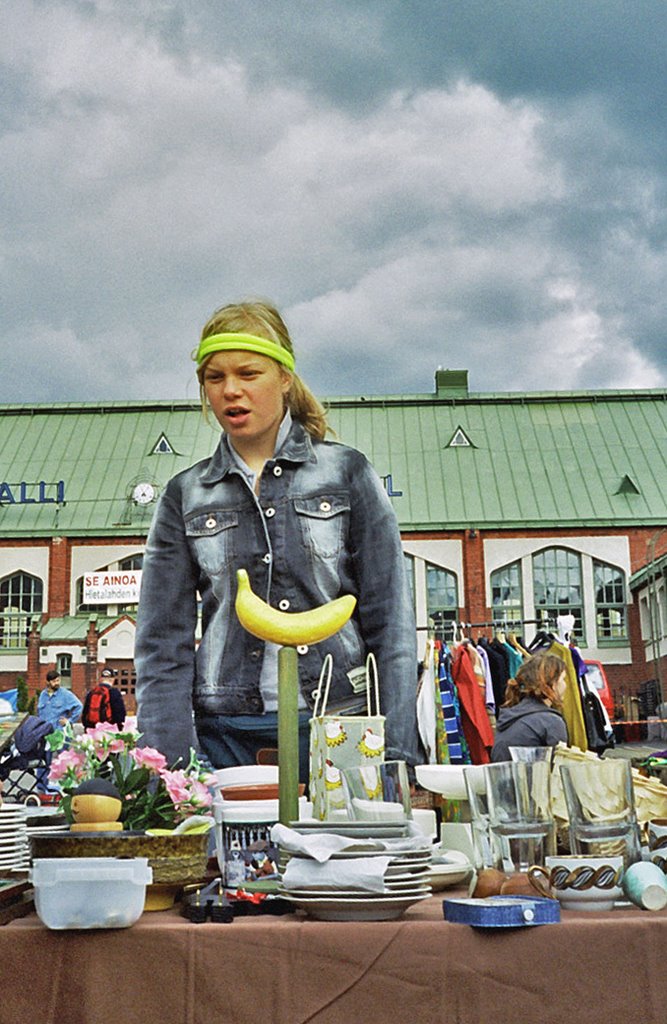 In the last post I mused about how digital promotes a type of visual illiteracy. The other kind of visual illiteracy I'm sure automatic digital zoom cameras have encouraged is the tendency of people to stand wherever they find themselves and zoom to fill the frame with the subject. People who started out with zooms and follow the inclination to shoot this way are never going to learn composition. Not only do they likely fail to consider secondary details that could be in the frame if they didn't zoom so far--and which might make for a more interesting or balanced composition--they also have no concept about perspective. I've seen people on Internet forums trying to explain that perspective is determined by the position of the camera relative to the subject, and those reared on zooms often just don't get the difference between moving your body and zooming. When zooms were first introduced, of course, manufacturers imagined them within the paradigm of the fixed-focus world they came into. The idea was that every competent photographer would size up the scene, decide what focal length it called for, set the zoom for that focal length and only then put camera to eye and maybe do minor framing adjustments. I suspect some pros still use that kind of discipline. The average person today doesn't even think in terms like "I need a [35/50/85]mm lens here" etc.
  I figure zooms also delivered the final blow to the head of once fairly popular 135mm short telephoto lens, which already seemed like a "tweener" focal length on an SLR—too long use indoors, too short for a lot of "real" telephoto chores. And it fell right in the middle of a range (70-200mm) that would be covered by your "long" zoom. So R.I.P. They still make them, of course, but I can't imagine many people buy them. A little-known fact is that 135mm became a standard focal length because it is the longest lens that can be reliably focused with a Leica or other 35mm rangefinder with similar "rangefinder baselength." The Nikkor 135mm f/3.5 was one of the three original Nikkor lenses that David Douglas Duncan famously chose over Leica and Zeiss to cover the Korean War in 1950. The others were a 50mm f/1.5 and an 85mm f/2. He and some colleagues tested them and found them better by whatever standards they were applying than the comparable German glass. This choice was well publicized and helped secure Nikon's reputation (one account has Nippon Kogaku being run out of a garage when Duncan found them, but I don't know if that's true). German purists insist that the Nikon lenses were probably only better in the contrast qualities desired for magazine work, not in resolution overall. And they were all Zeiss designs the U.S. got as part of its reparations (Wikipedia: "Germany paid reparations to France, Britain and Russia, in the form of dismantled factories, forced labour, and shipments of coal. The U.S. settled for confiscating German patents and German owned property in the U.S., mainly subsidiaries of German companies." That's our U.S., ever the good sport.) I'm not fully clear on how a Japanese company wound up with them.
Labels: film cameras, photography, photos
posted at 12:10 AM
 Someone writing on a photography forum today, telling a story involving family members, noted: "They are normal people and have only two cameras." (This isn't a posting about the number of cameras I have—suffice it to say it is greater than the number of the constitutional amendment I might allude to if pressed to say how many cameras.) Reading that got me thinking about how the prevalence and penetration of digital photography has changed the relationship of normal people to photography. Carrying forward the automation that began with film cameras, consumer digital cameras make it very easy to take photographs with no glaring technical deficiencies. Something is usually in focus, the shot is exposed well enough, etc. And if you do mess one up badly, you'll be able to see that and shoot it over until you get it right. This seems to me a major source of the increasingly prevalent supposed truism that "digital cameras take better photos" (better than what is not so often stated, but we suppose the reference is to dad's clunky old film gear).
 So it's possible to produce recognizable photographs without knowing what used to be considered the first thing about photography. Nothing wrong with that, in a way. However, I'm starting to think that soon the average person under thirty is likely never to have seen an amateur photograph taken with film equipment. (Why I love film cameras.) The result is a somewhat sad kind of multi-level image illiteracy. I'm musically illiterate, so I'll analogize to that. Most people wouldn't recognize that it would be impossible to take the images in this entry with any digicam they are likely to ever touch (I'd be unlikely to notice that a piece of music was played with only the white keys on the piano). Most people would think they could create images like this if they understood their cameras better, as I might think I could replicate a certain piece of music if I knew my white-key-only instrument. Neither they with their consumer digicams nor I with my deficient piano knows enough to understand the instrument's limitations.
 These adorable children were in places without huge amounts of light. A typical parent's typical digital camera on automatic would have bathed these scenes with flash. Could you detect that the most critical fact about these images is that they were taken using natural light? Did it also immediately strike you that the backgrounds in the last three images are nicely blurred to indistinction, and that the sea of colorful toys has a nice level of blur too? Without the blur, these would be much different photos—much worse, in my opinion. If you took these with the newly proverbial any-digicam-you-
 Over time, I think, there will be fewer and fewer images like these floating around among what the bulletin board poster called "normal people." Already, few people are probably even aware that it's possible to blur out a background like that. Soon enough, images with certain qualities will more or less disappear from the average person's visual vocabulary, so not only will they not miss that kind of image, but they won't recognize the distinctive characteristics of the few such images they may happen to see. Digital makes competent execution easy, but there is a cost.
Labels: film cameras, photography, photos
posted at 10:55 PM
Atlanta (June 17, 2006) — Researchers at the Georgia Institute of Technology have completed a prototype device that can block digital-camera function in a given area. Commercial versions of the technology could be used to stymie unwanted use of video or still cameras. [LINK]Ah, but their yellow-jacket style is no match for my striking-ASP(H) style!
Labels: film cameras, photography
posted at 1:05 AM
 |


