This April 30, 2008 Wall Street Journal editorial deserves to be quoted in full:
Readers with little girls at home don't have to be told who Miley Cyrus is. Their daughters want to be Miley Cyrus. The Disney Channel singer/actress is the star of "Hannah Montana," one of the most popular shows on TV. Her latest album is No. 3 on Billboard magazine's bestseller list. Reports estimate that she will bring in $1 billion in business to Disney this year.
She is also 15. Thus this week's uproar over a seminude photo by Annie Leibovitz for Vanity Fair magazine. The photo – showing Miley draped in a sheet, back bared, hair tousled, with a come-hither smile – upset countless parents who immediately grasped the photo's essential vulgarity.
Such ordinary wisdom apparently escaped every so-called grown-up involved in the photo shoot. The sophisticates at Vanity Fair defended the picture as a "beautiful and natural portrait." Absent sensible adults, Miley herself stepped forward to issue a statement saying that the now-embarrassing photo shoot was supposed to be "artistic."
Next to what crosses TV and computer screens every day, Miley's photo is relatively tame – save for the fact that Vanity Fair was trying to lower the bar on this stuff to the age of 15. Parents have enough difficulty teaching their daughters how not to expose their bodies in a vulgar way; this makes it harder. If there's good news here, it's that folks in Buffalo, Charlotte or Iowa City are still insisting on cultural norms alien to the elites of Manhattan or Hollywood.
"Essential vulgarity"? "This stuff"? (and, for that matter, "come-hither smile"?) Is there some standard I don't know about where art directors and iconic photographers are supposed to speculate about (or even concern themselves with) what may or may not "upset countless parents." And did this tame photo really "upset countless parents"? Whose even more countless kids were reading Vanity Fair? Looking at the VF website, we see that her (so-called grown-up) parents were present for the photo shoot, which appears to have taken place on a farm.
It's 2027. Do you know where your baby pictures are?
My brother, one of the new parents I mentioned in the recent post about digital photography, isn't buying my pessimism about how long today's digital photos will be around. He writes:
I think you need a more detailed analysis on your blog about exactly what you think is going to happen with the digital photos. Currently JPEG is probably the most common format in the world. One can assume that 100s of millions are taken daily. You don't think that format will be supported in 20 years? I think you're crazy. At the bare minimum, there will be common and free programs to convert your existing JPEGs to whatever format is prevalent at that time. But I've been doing computer graphics stuff since 1993 . . . (14 years ago!! Close to 20!) and all the formats that existed then exist now—PSD, TIFF, PICT, EPS, etc. Even the unusual formats can be converted with specialized software like Debabelizer. Program files (WP, Quark) may get harder and harder to open if you don't keep them updated. But standard file formats, I don't see an issue.
50 years—maybe.
And of course, if the files are lost, destroyed, deleted, etc. But of course that can happen with anything in life, including prints and negatives, which can go bad as well and usually only exist as one copy.
The following is a version of my response to him.
What I see happening is that the average person's photos will become unavailable for all practical purposes through a combination of creeping technological obsolescence and human nature. You can't just look at the strongest link in a chain (the file formats, maybe) and conclude that the chain is sound.
I don't dispute the basic premise that these digital files are eternal, in theory. A row of ones and zeros is eternal. And the main file formats probably will continue to exist indefinitely, although I'm not positive about that and it seems possible that there are already issues on the horizon with JPEGs, such as perhaps they will not contain the amount of color-space information expected in the future.
It is definitely possible for a diligent person or organization to make sure all of their digital files are preserved and accessible on an ongoing basis. This is mostly the province of users who rely on their files professionally. My guess is that even the most diligent of these users carry less than all of their files forward, relying on their contemporaneous expectations about what they will need in the future. The accuracy of those expectations is open to question, naturally, but that's beyond the scope of this discussion.
What I'm predicting is that the average person's photos taken today are not likely to exist in a practically accessible form in 20 years, give or take. By "average person", I mean the 99% of the population that relies on digital photography to record memories but to whom everything my brother wrote above past JPEG would be unfamiliar gibberish. I mean the layperson who thinks that recordable CDs are robust like commercially-recorded CDs and will last forever, who thinks once something is on CD in a drawer somewhere, it's safe. I mean the person who, when he gets a new computer, transfers the main data files and puts the old machine in a closet since "some of my old files are still on there." I think I am describing most people.
When it comes to preserving their data, most of these people will end up proving the old adage "failing to plan is planning to fail." They find out that JPEGS etc. are likely to exist for the foreseeable future, and they move on to more pressing matters.
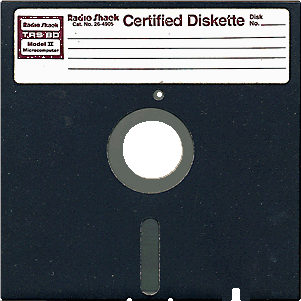
Today, a person with a bunch of digital files looks forward, if he does at all, and sees a nice gradual progression of technology receding into the future. But I think there are many, many ways that over 20 years the files can disappear or become unavailable absent great effort. As an example, I think of my own college and law-school papers, which I wrote on the old Leading Edge Model D (640K of RAM!) using WordPerfect 4.0 and MS-DOS. These are stored on 5-1/4" floppy disks. For a while after I wrote these minor works of genius, I continued to own my Leading Edge. One day, I gave it to my girlfriend's mother because it was obsolete and she needed a computer. (I didn't replace it at the time with another home machine, which means that there was a time in the pre-WWW era when I figured I had a computer at work so didn't need one at home—how bizarre that seems to me now.) I stopped having a computer that supported the 5-1/4" floppy storage medium (I can't recall if there were machines that had both 5-1/4" and 3-1/2" drives—probably, but I think most people leapfrogged directly to 3-1/2"-only setups), which ended whatever "in-house" capacity I may have had to port the files to another system. Eventually Windows replaced MS-DOS, the "DOS shell" function vanished, WordPerfect almost disappeared, Word stopped supporting that legacy file format, etc. At no point in the 20 years since I wrote the first of my college papers was there one event where they disappeared or became unreadable, yet for practical purposes they unavailable to me. And still they have not vanished. I have the floppies in a box in the basement somewhere. But even though I think from time to time that I should find a company to get them off the floppies and into a readable format before it's completely too late, that is not a priority and, realistically, probably won't become a priority at any time in the future. So my papers are on their way to really being gone. In much less than 100 years there will be no trace of them.
What happened (is happening, really) with my college papers is completely unique in its particulars and, I think, very typical on the level of practical experience.
It seems to me that some version of the foregoing will happen to most of today's digital photos. The average person is giving roughly no thought to systematically preserving images. They sit on hard drives, maybe backed up on CDRs or DVDs, all media with significant failure rates and that depend on various bits of today's technology to make them work. It's hard to predict what transition among all those of creeping obsolescence will have the single greatest impact. Perhaps when USB cables disappear. Or CDs. Today you might hear "then I upgraded to a PC that didn't have a floppy drive." What will you be hearing in twenty years?
Ultimately, I think the combination of constant technological change and human nature is what will doom (most of) most people's photos. The absolute impermanence of various recording media is a secondary concern. The stability of encoding conventions like JPEG hardly enters into it. Realistically, favorite images may be saved and a lot of others will not be. Perhaps companies like Google end up assuming (more or less by default) a quasi-archival function for the photos of average people.
It's true that "one-copy" physical media don't always last, and are vulnerable to various (individually very improbable) catastrophes. You could come up with an annualized rate at which this could be expected to happen. It is a rate that is not too much affected by lack of specific human attention. In 20 years, most of the film sitting in the backs of closets will still be fine. Any digital files stored that way will be unavailable (someone could "back out" an imputed annualized rate of decay for digital files left sitting unattended, which would interesting to see). In terms of other stuff you have around the house, film is more like a book and digital is more like a houseplant. You can keep the houseplant alive for a long time, and if you propagate it right maybe it will live forever. But the book just sits there and is fine for a long time with no attention. And how many of our grandparents' houseplants do we have? This is not a perfect comparison, to be sure, but interesting to think about.
There is an interesting online discussion post by a professional photographer who does lots of work for major clients and has been fully digital in his studio for 7+ years—a serious guy. I don't think the comparison he makes with old videotape is entirely apt, but it makes you think. His point about digital RAW files is one I had not considered. He points out that RAW (what you shoot in digitally if you are "serious") is not a standardized format at all. His basic point: "Digital is disposable in my book."
As a long-term archiving solution, recording digital images on film is accepted as one of the most reliable and stable storage methods. Here are some interesting observations from a somewhat biased source, a company selling film recorders or film recorder archiving:
Digital Data Archiving Gets Neglected
In business as in private life the long-term storage is neglected. Documents of considerable historical and sociological importance will be lost. Even in professional archiving institutions the digital archives all have a astonishingly short 'shelf-life'.
It becomes necessary after 10-15 years to transfer the entire digital archive from one storage system to another with increasing costs.
Digital Media with an Expiry Date
Digital storage media age and at a much faster rate than analog ones. CD-ROMs have been and still are one of the most popular storage media, yet they are among the least durable media we have. Egyptian papyrus or documents of medieval Europe survived for centuries.
Missing Storage Systems and Computers
Storage media develops as fast as processors. The replacement of computer generations is significant in a number of ways:
when a system vanishes, data formats are lost
when a system vanishes, connections and system buses are lost
whenever a new system comes onto the market, this increases the pressure for change and the elimination of older systems.
Digital File Formats That Everyone Has Forgotten
Not only the physical durability of the media themselves and the usability of the storage media is limited, but also the file formats used for the information also change roughly every ten years.
Practically speaking, this means that every ten years when the inevitable transfer of data takes place, a certain proportion of the data won't be converted and in time will become unusable. This is of course the very opposite of what archives, museums and libraries were established for in the first place.
Here's something interesting from Stewart Brand that echoes my college paper situation:
The loss is already considerable. You may have noticed that any files you carefully recorded on 5l/4" floppy disks a few years ago are now unreadable. Not only have those disk drives disappeared, but so have the programs, operating systems, and machines that wrote the files (WordStar in CP/M on a Kaypro?). Your files may be intact, but they are as unrecoverable as if they never existed. The same is true of Landsat satellite data from the 1960s and early 1970s on countless reels of now-unreadable magnetic tape. All of the early pioneer computer work at labs such as MIT Artificial Intelligence is similarly lost, no matter how carefully it was recorded at the time. The pioneer work of today is just as doomed, because the rate of digital obsolescence keeps accelerating, and the serious search for a long-term strategy for storage has yet to begin.
I would love to get some comments on this entry. What do you think about these points? Do you think the average person will have access to today's photos in 20 years?
I recently tried to sell my mother, the recently-minted grandmother of a one-year-old (my niece), on the idea that she should be taking photographs of her granddaughter with a film camera. My idea was that if she were to spend $60-100 for camera X, I would lend her very nice lenses Y and Z that I never use (including a Nikkor 105/2.5, if that means anything to you) and she would be able to take some lovely, natural light images of her granddaughter that would distinctively memorialize their visits.
Her response: "Jeez, there are so many photos of [her] available that I don't have a great urge to take more."
I couldn't argue that that there are a lot of photos of her available. Most of them are digital record shots taken indoors with flash that I am not sure will be around in 20 years, but it's true that there are lots of them. Rather than insist, I went back to dangling the same offer in front of a friend who already favors film for shots of her kids. She might yet take me up on this.
Soon after the exchange with my mother, I saw a segment on Nightline about how the advent of digital cameras and editing programs is increasingly enabling average people to take "perfect pictures." Then I read an article in the New York Times about the often absurd shutter lag of consumer digicams. This piece opened with typical NYT digicam fawning—"Digital cameras are amazing"—and then went on to detail issues that would ruin the experience of any serious person trying to use one these sluggish cameras.
All this made me think about the several new parents I know who, while keeping the many balls of new parenthood aloft, have been memorializing their children with consumer digicams. It's the easiest thing to do, of course. I have already explained some of the reasons that I think this is a bad approach that both the parents and the children will be sorry about later, but I recognize that it's what most people are going to do. So I thought I would come up with a few suggestions and considerations about recording your child's life with a consumer digicam.
Try covering your camera's flash window with a piece of frosted cellophane tape or the frosted part of a Post-It tape flag. This will moderate and diffuse your flash and make your flash photos look somewhat better. You will likely decide to leave the covering in place permanently.
Experiment with pretending that your camera does not have a flash, a display screen or a delete button. Be alert for opportunities to shoot without flash. Compose your shots with the camera's optical viewfinder and pretend that you won't have the opportunity to review them later. Pretend that you have limited storage and need to make every shot count.
Treat photography partly as a separate activity, not only as an adjunct to everything else. Take advantage of overcast days to go outside and get some shots with diffuse natural light. Plan photos in the shade or natural light. Try to get some candid shots with your child's attention focused elsewhere than on the photographer.
Consider the distinct possibility that if you have given no thought to how your digital images will be perpetuated in a viewable form over decades, that in itself may be an indication that they will not be. I think about my own college papers, the earliest of which I completed more than 20 years ago. I didn't give much thought to how I would be able to read the files in the future, and now it would take an extreme effort to read them. They are on 5-1/4" floppy disks, in WordPerfect for MS-DOS format. They are for most practical purposes already gone. I think the photos you are taking of all these irretrievably precious moments are likely to suffer the same fate. Some might not, most will, and your lack of any kind of plan makes it very likely that I will be proven right. So shoot some film.
A reader named Melissa S. e-mailed to say that she explains Iraq policy to her 8-year-old son in terms of Harry Potter characters: “Dick Cheney is Lord Voldemort. George W. Bush is Peter Pettigrew.” Don Rumsfeld is Lucius Malfoy, while Cornelius Fudge represents administration supporters who deny that anything is wrong. And, she concludes, “Daily Prophet reporter Rita Skeeter is Fox News.”
That was one of the 400 comments from readers offering literary or historical parallels to the Bush administration and Iraq. - Nicholas D. Kristof, New York Times, February 4, 2007
Now this, surely, is child abuse. I am so thankful that, when she read The Lord of the Rings to my brother and me during the Nixon/Vietnam era, my mother did not sully the magic by mixing in contemporary politics. At least those were adult books (sort of). I can't imagine teaching a child of eight that the real world is as black-and-white as the morality of a children's book. That same Melissa S. is probably overprotecting that kid in all sorts of meaningless ways even as she ruins him in the way she proudly confides to Kristof.
In the same column, Kristof asserts that "Sun Tzu and Julius Caesar alike also appreciated the diplomatic benefits of treating enemy prisoners well; they would be appalled by Abu Ghraib and Guantánamo."
Yes, the Romans were famous as generous victors. The leaders of the conquered peoples would be paraded through Rome and executed midway through the proceedings. (I don't imagine things were a lot more friendly in China, circa 500 B.C.) I'm sure I don't have to explain where the Romans got all those slaves.
I have long had the idea that I will be a very good parent, somewhat in the Atticus Finch mode as best I recall that. As you might suppose, I have a few interesting ideas about parenting already, and expect that I will be able to figure things out very effectively when the time comes. (There will be many, I'm sure, who think I can't possibly imagine how it will feel to be a parent, etc., and of course you have a point, but give me a little credit too.) I tend to believe that the kids will turn out pretty well almost by default, and yet that I won't be able to protect them from many of life's real perils and disappointments. The most interesting parenting questions, for me, are about how to keep the little ones from turning out like me in few specific areas (wouldn't you like to know?). And, of course, which DVDs will best nurture their little inner high-energy physicists when shown repeatedly to give me short intervals of peace.
I'm fascinated by notions of "protecting" children from exposure to this or that from the real world. To a greater extent than almost anyone, I suspect, I scoff at the idea of "age appropriateness", or at least the idea that parents should be actively preventing their children from encountering certain facts, ideas and points of view. I know parents who don't want their pre-teen children to learn about the existence of homosexuality from overheard conversations or whatever (a code word takes the place of "gay" or "homosexual" in parental discussions). Another friend with young children recently expressed dismay that a parent was watching a PG-13 movie with a five-year-old. The specific issue: the word "hangover" came up.
I can see why there is the impulse to shelter the children. For any parent who grew up without the Internet, cable TV and movies on video, it must be striking what kinds of things these media commend to a child's attention. I'm sure I had a more sheltered youth than it would be easy to have today without parental intervention/censorship. But there was still a lot of harmless exposure to all sorts of grown-up themes. Although my friends and I watched all of Monty Python on PBS during grade school, I think whole categories of the humor ("He used to ram things up their . . .") just didn't register with us. I suppose if I'd asked my parents what Eric Idle's soldier character had been up to, there might have been some interesting moments, but I like to think they would have told me true things and not restricted my PBS viewing. And it can be kind of charming the way kids learn about "adult" material. One big debate in my circle during sixth grade was whether we would get in trouble for saying "Jane, you ignorant slut!" on the playground. Now that's just cute. (The word "slut" was in our blue-and-yellow school dictionaries, defined as "1. A dirty, slovenly woman. 2. A prostitute." I remember the definition precisely because, to settle our dispute, my friend pulled out the dictionary and read out the definition just as—in one of those coincidences found only in real life and great fiction—our teacher quietly entered the room and took up a position behind him.)
Anyway, some five-year-old has no idea what a hangover is. That doesn't mean he can't be exposed to a film with that concept in it. It's probably not going to register. If it does register, and he asks, "Mommy, what's a hangover?", I don't see how that harms anyone. When it's explained, in five-year-old terms, the kid will still have a very limited understanding (like when I read about superstring theory in the newspaper), and I don't really see the harm (indeed, why isn't it a "teachable moment"?). I'm not suggesting it's a good idea to inundate five-year-olds with the idea that hangovers are a normal part of life. But it's far worse to shield your kid from the world, or try to stage-manage the timing of when he finds out things about the world. You won't catch everything anyway, and your kid could end up with some strange, incomplete notions from the bits that do get through.
And it's far from clear that those Monty Python episodes weren't the most important and valuable part of my education in fourth grade.
Wonderful to meet you, Mike. And Mrs. Teevee, how do you do? What an adorable little boy you have.
In my recent post about children, parenting or whatever, I almost wrote about how shocked I was the first time I saw parents show up at a family member's home with their small kids, whip out a videocassette and plop the kids down to watch some Disney cartoon or such like that they had seen a million times already. This would have been around 1990, and I was on record with my companion at the time about how bizarre it seemed to me that the educated, engaged parents would do such a thing without the slightest shame. Since then it has become commonplace to use television and videos as electronic babysitters, but I always remember how startled I was the first time I encountered the phenomenon. It seemed obvious to me that the kids would be getting less of developmental value from their nth viewing of some cartoon than from almost any other possible activity.
Now comes the suggestion that all this early TV watching might be the mysterious "environmental factor" behind the huge rise in autism cases that has been one of the big contemporary medical mysteries. An interesting study by Cornell University researchers seems to lend support the TV hypothesis. The methodology is creative, establishing a correlation between TV watching and precipitation, then examining autism rates in areas of western states with divergent precipitation levels, and also examining the relationship between when certain areas got cable television service an their autism rates. It also notes that you don't see expected levels of autism among the Amish (but I note that the Amish population might not have some predisposing genetic factor in the same proportion as it is present in the wider population). Anyway, it's all very interesting, and hardly conclusive.
I take a certain satisfaction that those shrill, conspiracy-minded, anti-intellectual parents who have decided childhood vaccinations (and insignificant amounts of mercury therein) caused their children's autism might in fact have only their own corner-cutting, lazy parenting to blame.
Gee, when I say it that way it sounds a little harsh. Perhaps multiple viewings of The Little Mermaid will placate me.
I sometimes feel I could write a short book about all that troubles me about the state and status of children in modern America. Or maybe it is that state of parenthood and parenting I would really be writing about. Among the topics I might explore:
the idea that the best interests of the child in any given situation must be paramount
the idea that children must be afforded every possible explicit opportunity more fully realize their presumed gifts
the idea that children must be shielded from knowledge of the world that every adult has somehow managed to acquire, and the coordinate idea that information on certain topics is properly doled out on a need-to-know basis and "when they are ready, they will ask"
overindulgence and undersocialization of children
I picture myself being sort of an Atticus Finch kind of parent, but I suppose time will tell. Some people think it's impossible to predict how you will respond to being a parent until it actually happens. I think such people are usually imagining their experience is somehow universal, and they tend to be less analytical than I am and have less capacity to project how they will react to things that have not occurred. Some people will now say I'm flattering myself and just wait until you're a parent, etc. I guess we'll see.
Not being a parent now, I'll occasionally discover some striking common mode of thought among parents that would never occur to me naturally. Recently I was formulating preliminary plans for an event and someone suggested that I needed to come up with a firm policy about whether people could bring their children. Apparently it can be annoying to parents if they get a sitter and then show up to find others brought their kids (something about preferring the company of their own kids to other people's kids). I mentioned this to a new parent in an email message, adding that I don't really appreciate these nuances since to me all kids are someone else's kids.
My always-candid correspondent's response: "I totally get the nuances. The difference between one's own kid (who seems special and amazing at all times) and other people's kids (who seem kind of pointless and irritating) is staggering."
Which leads me to wonder if there isn't a thin line between parental love and narcissism by proxy.
Sometimes "Oh, my goodness gracious" really is the only reasonable response
"I'd ignored his previous e-mails (I get way too many e-mails from random blog readers to reply to all of them, and I certainly don't reply to those from people who don't sound very intelligent or interesting) but apparently that had not deterred him." - Jacqueline Mackie Paisley Passey, blogger and unsuccessful Washington State Libertarian Party candidate for statewide office (sorry for the redundancy in that last bit)
Coincidentally, just this evening I was discussing with my dear friend CLD the importance of keeping one's children from turning out this way.
Fortunately, I suspect it's hard to mess up your kids this badly without dedicated effort. Whatever weird little atomic pile of arrogance Jacqueline Mackie Paisley Passey's parents kindled in her after the preposterous christening has evidently been self-sustaining for some time. I think that's a four-Σ sentence, by the way, you stupid bint. (Sorry, had I implied that I'd turned out perfectly?)
I was delighted to stumble across this blog while reading some of the comments on the above. At first skim, it shows some nice elements of the "memoirs of a monster" genre.
I have a very old and battered cookbook on my shelf called The Everyday Cook-Book, which I took down this evening to scour for blackberry recipes. The front few pages are missing, but a reference to "the recent advent of the Jersey Lily" (Lillie Langry) suggests the 1880s. I haven't found any blackberry recipes yet (perhaps the Himalayan blackberry had not been introduced to these shores back then), but I am finding all kinds of useful wisdom to pass on to you, my loyal but sometimes benighted readers. It's much more than a cookbook, as you will see from what follows.
Some parents allow their children to acquire the very rude and unmannerly habit of breaking in upon their conversation and those of older persons with questions and remarks of their own. It is very uncivil to allow them to do so.
—&mdash
Some girls think it is interesting and attractive to be terrified at insects, and will shriek with fright if they happen to be chased a few rods by a flock of geese, but they only excite laughter and do not gain the admiration which a brave girl who tries to help herself would deserve.
—&mdash
A sun-bath costs nothing, and that is a misfortune, for people are deluded with the idea that those things only can be good or useful which cost money. But remember that pure water, fresh air and sunlit homes kept free from dampness, will secure you from many heavy bills of the doctors and give you health and vigor, which no money can procure.
—&mdash
Pictures are both for use and ornament. They serve to recall pleasant memories and scenes; they harmonize with the furnishing of the rooms. If they serve neither of these purposes they are worse than useless; they only help fill space which would look better empty, or gather dust and make work to keep them clean.
A room filled with quantities of trifling ornaments has the look of a bazar and displays neither good taste nor good sense. Artistic excellence aims to have all the furnishings of a high order of workmanship combined with simplicity, while good sense understands the folly of dusting a lot of rubbish.
A poor book had best be burned to give place to a better, or even to an empty shelf, for the fire destroys its poison, and puts it out of the way of doing harm.
—&mdash
TO MAKE COFFEE
Take a good-sized cupfull of ground coffee, and pour it into a quart of boiling water, with the white of an egg and the crushed shell. Stir well together, adding a half-cupful of cold water to clear. Put into the coffee boiler and boil for about a quarter of an hour; after standing for a little while to settle, pour into your coffeepot, which should be well scalded, and send to the table. The coffee should be stirred as it boils. To make coffee au lait, take a pint each of hot made coffee and boiling milk; strain through thin muslin into coffeepot, to get rid of the grounds, and serve hot.
—&mdash
[Handwritten in pencil on a sheet of torn ledger paper, laid in:]
Swell Cake
1 scant cup of lard 1 cup of sugar 1 egg (beat white seperate) 1 cup of sour milk / or 1 " " coffee cold mix with one tea S soda 1 heaping tablespoon cocoa 1 tea spoon ground cloves 1 " " " sinoman 1 cup seeded raisans 1/2 cup molasses 2 cups flour use more if needed 1 tea spoon of baking Powder
—&mdash
[Typed two times on a sheet of paper, laid in:]
FORMULA FOR CANCER CURE
Equal parts of each of the following:
Blood Root-----Chloride of Zinc-----Flour
Mix the blood root, flour and zinc to form a thick paste . . . .
Memorandum to Swine in Human Form Who Litter in the Backcountry
M E M O R A N D U M
TO: Swine in Human Form Who Litter in the Backcountry FROM: MWR RE: Punishment DATED: July 22, 2006 ---------------------------------------------------
I can't understand how your like even learns about places like this, or what impels you to bring a little bit of your degraded existence to remote and beautiful settings for which you lack any respect.
Be glad your punishment is not up to me, person who deposited a jumbo candy wrapper beside the trail to Gothic Basin yesterday, or you would be missing a joint of your pinkie. Each of your parents would be missing two joints.
I ran across this photo in someone's baby blog recently, under the caption "Have you ever seen a more beautiful basket of flowers?" (answer: yes, but that's not my point.)
Apparently this was the poor kid's birth announcement, which also isn't my point. This is the sort of "At Rest" photo people used to have made when their babies were taken from them by diphtheria. Yet even that is not my point.
It's natural for parents to adore their children, but would it kill them to have a little perspective when it comes to sharing the baby's life story? Key point to remember: it's a baby. Secondary point to remember: it's not the first human baby to be born on earth in more than a thousand years.
The standard online parental trope--almost unswerving so far as I can tell--is to show profuse photos of the baby and more or less pronounce it the most amazing baby ever. I know there's often irony in hyperbole, but the standard trope almost never allows any irony to come to the surface, if indeed any is present at all. Of course there's seldom any good-natured ribbing of the baby, even though it would never know the difference. What I wouldn't give for the occasional caption reading "Cassia still can't figure out that aspirin bottle--I don't think we'll be seeing differential equations from her anytime soon!" or even "We're hoping the outsized head means Dieter will be some kind of genius."