R.I.P. Donald Fleming
But there's one more thing you should know about Hei—deg—ger . . . and you're not go—ing to liiiike this: HE WAS A NAZI!—An unrepentant Nazi until the end of his life.
Professor Donald Fleming
died last month. Fleming's four wonderful intellectual history courses defined the concept of a "work gut" (go to class, read two novels), yet taught us so much. His lectures, incomparable
tours d'horizon, should have been collected. It's tragic that they aren't available on video somewhere.
Labels: Harvard

Really, though, the hardest thing about being a zombie at Harvard is getting in

“The Harvard Zombie Massacre,” which is still in its preliminary phases, is to be produced by Hollywood veteran Warren Zide.
Zide, who produced the “American Pie” series as well as the “Final Destination” series, has a great deal of experience with movies featuring college-aged students—as well as those featuring rather gruesome fare.
Ryan Lewis, who will serve as the movie’s executive producer, said that the project has a rather unique appeal.
“So, the world’s smartest college students have to battle the world’s smartest zombies,” he said. “Usually you get serial killers and ghost stories and stuff with college kids. There hasn’t been a college zombie movie yet. It will have that great cheekiness, some great horror moments—it’s really a great blend.”
As the title suggests, Harvard students will engage in a battle of wits with their undead counterparts. Lewis hopes to film the project right in Harvard Yard, though they have not yet sought the administration’s approval. - Harvard Crimson, June 28, 2008
Unfortunately for the marketing campaign, Yale University holds common-law trademark rights to the phrase "the world's smartest zombies."
Labels: Harvard, the world's smartest zombies
Yes, it's all about value at our trade school
Harvard came out at the top this year for the Best Value ranking—which rates schools based on how much a student is expected to get out of their education for the money they pay—passing the California Institute of Technology, which held the top spot last year but dropped to fourth for the 2008 list. - Harvard Crimson, August 25, 2007
Labels: Harvard
What Larry said
In case it is of interest what Larry Summers actually said, you can read it
here. My impression is that very few people who talk about it in sound bites have done so. Here is one passage of particular interest:
If one supposes, as I think is reasonable, that if one is talking about physicists at a top twenty-five research university, one is not talking about people who are two standard deviations above the mean. And perhaps it's not even talking about somebody who is three standard deviations above the mean. But it's talking about people who are three and a half, four standard deviations above the mean in the one in 5,000, one in 10,000 class. Even small differences in the standard deviation will translate into very large differences in the available pool substantially out [i.e., out on the right tail of the associated bell-shaped curve].
Regardless of what you think of Larry Summers or the exactly even distribution of aptitudes and abilities among persons, this is something—like the
base-rate fallacy—that is good to understand when reasoning from and about statistics.
Labels: Harvard
Harvard Crimson reports that the next president will be Drew Gilpin Faust
Faust Expected To Be Named Harvard President This Weekend
Radcliffe Institute Dean, if approved, will be Harvard's first female leader
Drew Gilpin Faust is expected to be named Harvard's 28th president this weekend, according to three sources familiar with the situation.
The Board of Overseers, the governing body that must approve the appointment, has scheduled a special meeting Sunday, two sources said.
The Overseers meeting had not been on the board's regular schedule, and it is unlikely that any candidate other than Faust, the dean of the Radcliffe Institute [formerly Radcliffe College - MWR], will be presented for approval, the three sources said. - Harvard Crimson, February 8, 2007
Interesting. If this is true, her selection ends remarkably leaky process. The Crimson seemed to know most of the key names, and a number of them made more or less public shows of removing themselves from consideration. Consequently, there may be an impression that Faust is not the first choice, and I think there may be some truth to that. It's too bad they could not maintain a secret process so that the new president would enter the challenging job with an unquestioned mandate. But that shouldn't matter for long if she has what it takes.
She will be there first president since the first two (and since 1672) not to have a degree from Harvard. The first two had various Cambridge degrees, all granted before Harvard existed.
Labels: Harvard
A weak proposal, dispensed with
The task force charged with overhauling Harvard’s Core curriculum has dropped the "reason and faith" requirement from its proposed list of general education courses.
While the proposed requirement—unveiled with the task force’s report in October—generated nationwide headlines and heated on-campus debate, it died quietly today at a meeting of the full Faculty of Arts and Sciences. - Harvard Crimson, December 12, 2006
This was always a suspect proposal. Steven Pinker offered an
excellent critique of the proposed "reason and faith" requirement that is well worth reading. I would only add that the impulse behind the proposal smacked of post-9/11 and post-2000-election intellectual vogues: Why do they want to kill us? Why do they want those goofballs to govern us? Why do they think someone designed us (and why aren't they suing said someone for
negligence)?
Labels: Harvard
E.O. is more than just a Police lyric
What is it with me and
Police lyrics lately? Maybe I'm just trying too hard with the headlines. Anyway, I don't usually comment on the
amuse-gueule quotes, and it is usually a reliable assumption that they are made up.
Not always, though. I can report that I was present in Science Center C in the fall of 1985 (Science B-15. Evolutionary Biology) to hear E.O. Wilson say the above in response to a question about Stephen Jay Gould. My admiration for Wilson ratcheted up several notches immediately from its already high level.
(For latecomers, this post refers to "Gould and I agree about everything that he understands." I don't call them
amuse-gueules for no reason. They disappear quickly.)
Labels: Harvard
Rah!
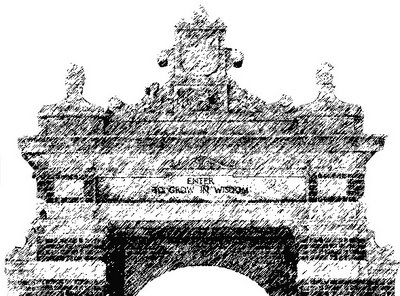
The
world university rankings 2006- Harvard
- Cambridge
- Oxford
- Massachusetts Institute of Technology
- Yale
- Stanford
- California Institute of Technology
- University of California, Berkeley
- Imperial College London
- Princeton
Labels: Harvard
Who names these categories?

Under the new recommendations [of the Harvard Faculty of Arts and Sciences Task Force on General Education], students would be required to complete one half-course in each of seven areas—"Cultural Traditions and Cultural Change," "The Ethical Life," "The United States," "Societies of the World," "Reason and Faith," "Life Sciences," and "Physical Sciences." - Harvard Crimson, October 4, 2006
Labels: Harvard
Does Macy's tell Gimbels? The College of New Jersey to end early admissions.

A week after Harvard abandoned early admissions as a program that puts low-income students at a disadvantage, Princeton followed suit yesterday, saying it hoped other universities would do the same. "I think it's important for there to be momentum, because I think it's the right decision," said Shirley M. Tilghman, Princeton's president. - New York Times, September 19, 2006
——I agree with you that I think Harvard will end up with a class that is simply not at strong—period. The top kids will lock it in at another top school that offers early action. (I pray that Princeton doesn't drop EA—we can snag all the top kids for years to come!!). - MWR's old friend, a Princeton Early Action admit and alum, private email, September 15, 2006
——Oh, for crying out loud!!!!!!!! And we could have stolen all the Harvard people!!! - Same old friend, private email, September 19, 2006
Princeton has a secret weapon in the fight against over-admitting the affluent and privileged students: it could revert to the name it bore for more than half its history.
Labels: Harvard
Harvard will end Early Action admissions

Harvard University, breaking with a major trend in college admissions, says it will eliminate its early admissions program next year, with university officials arguing that such programs put low-income and minority applicants at a distinct disadvantage in the competition to get into selective universities.
Harvard will be the first of the nation's prestigious universities to do away completely with early admissions, in which high school seniors try to bolster their chances at competitive schools by applying in the fall and learning whether they have been admitted in December, months before other students.
Some universities now admit as much as half of their freshman class this way, and many, though not Harvard, require an ironclad commitment from students that they will attend in return for the early acceptance. - New York Times, September 12, 2006
I fear this is one of those ill-advised decisions Harvard sometimes makes out of its desire to be the first-mover and pace-setter in higher education. (In a sidenote deep in the article, we learn that "[t]he University of Delaware announced a similar move last May." You go, Fightin' Blue Hens!)
Harvard's non-binding Early Action program has long been a mechanism for building goodwill with a group of students who have had higher education at a top college on their radar for a long time. When Harvard admits some of these early, they tend to show up in the fall. I believe I once heard that the yield rate among accepted Early Action applicants is around 95%. By ending Early Action, Harvard all but ensures it will attract fewer of its admits from this important cohort.
Having once been the sort attracted by the Early Action option (full disclosure: I was an Early Action admit at Harvard and ended up going there), I can say with certainty that all of the students who would have applied early to Harvard will still be applying to one of the remaining handful of competing schools offering non-binding early admission. Early Action applicants have historically made up a disproportionate number of those that Harvard College admits, as evidenced by the fact that last year the Early Action acceptance rate was 21% and the overall acceptance rate was a little over nine percent. It follows from this that the regular-admission admit rate is a lot lower than nine percent. According a Newsweek statistic cited
here, for the Harvard class entering in 1999, 26% of the Early Action applicants were admitted (presumably this figure includes those who were initially deferred and then admitted on the Regular Action schedule) and six percent of the Regular Action applicants were admitted. Remarkably, 72% of the entering class was made up of Early Action applicants.
So, by eliminating Early Action, Harvard almost ensures that candidates from the applicant sub-pool accounting for nearly three-fourths of a typical entering class will apply early somewhere else. Harvard is effectively encouraging students it would have admitted early to instead be admitted early to some other great school, spend a relaxing holiday season reading glossy publications from the other great school, and then spend much of the spring semester being wooed by that school, wearing its sweatshirt, etc. Some of these potential applicants will not even bother finishing their applications to Harvard. Most of them will, but will spend three months happily thinking of Yale or wherever as their new home (hard as that may be to imagine for normal people who have spent much time in New Haven) before finally getting Harvard's fat envelope (or online equivalent) in early April. There sure won't be a 95% yield rate for these students anymore.
Harvard appears to have two main reasons for the change. Its leaders feel that the college admissions process would be better and better for the psyches of overachieving high schoolers if there weren't any early decision programs, and that Harvard should exert moral leadership and can afford to do so. And it can certainly afford to do so—I'm sure Harvard could fill two different and practically indistinguishable freshman classes out of each year's applicant pool, although the second such class might not have Harvard's usual share of the truly small handful of future Nobelists, concert soloists and the like entering college in any given year. But there are some significant game-theory hurdles to this kind of moral leadership being successful. It is akin to saying it's unfair that different people pay different prices for identically-equipped cars, so you're going to insist on paying sticker. Some colleges with a less noble sense of their own self interest are surely going to say to Harvard, in effect, "thanks for the moral leadership in subsidizing the great deal I just got on my car."
Harvard's second rationale is that Early Action, and early decision programs hurt "low-income and working-class students":
[A]t Harvard and many other universities officials have grown concerned that early admissions present a major obstacle to low-income and working-class students. Such students have also been hurt by steep tuition increases and competition with students from wealthy families who pour thousands of dollars into college consultants and tutoring.
"I think there are lots of very talented students out there from poor and moderate-income backgrounds who have been discouraged by this whole hocus-pocus of early admissions by many of the nation'’s top colleges,"’ said William R. Fitzsimmons, Harvard College'’s dean of admissions and financial aid.
I think the quote here from Fitzsimmons is silly, and sells short the very same talented students he wants to attract by supposing that, in this era of the Internet and common applications, students from "poor or moderate-income" backgrounds are just not going to be clever enough to figure out the process and get through it all. I don't mean to appear flippant, but if you can't figure out the admissions process, when you have to apply, when you need to have taken which tests, whether early admission to a particular school will be binding or not, etc.—well, how do you suppose it's going to be any easier at Harvard? As a general matter, anyone smart enough not to flunk out of Harvard should be smart enough to navigate an admissions process. Has Fitzsimmons forgotten the amount of "hocus-pocus" that used to be involved, before a lot of schools started accepting a common application? Good lord. Different schools called for entirely different essays. Brown, bless them, insisted that the essays be handwritten, and I'm pretty sure gave an explanation for this requirement that implied some amateur graphology (redundant, sorry) would be going on in Providence. More to the point, perhaps, it seems that a better way to help those who come late to the admissions process or are helpless before its mysteries would be to keep Early Action in place but extend the final deadline for applications beyond January 1 (more all-nighters for the admissions staff that way, though), or even adopt a system of rolling admissions.
Speaking of all-nighters for the admissions staff, getting rid of Early Action will require the staff to evaluate all applicants during a scant few months after January 1. To meet a compressed timetable, the admissions committee will either have to spend less time on each candidate's file, or add additional inexperienced staff. Either way, the thoughtfulness and overall quality of the committee's decisions is likely to suffer. The alternative would be to evaluate files as they become complete in the fall, making decisions on them but holding back on communicating those until April 1. However, this could recreate two of the problems Harvard is trying to address. If highly competitive students began to think there was an advantage to their applications being "first through the gate," they might clamor to submit them even earlier than they do now, suffering stress and psychological damage later evident in their plagiarized first novels. And there would still be the lifeboat problem I identify below.
I think the biggest reasons for eliminating Early Action are those that Harvard doesn't mention at all, and because of them the change will likely democratize admissions a little bit.
First, there is good reason to think that Harvard is not actually applying the same standard to Early Action and Regular Action candidates, even though it claims to. When do you suppose they were most magnanimous when filling lifeboats on the
Titanic, at the beginning or after they started to run short of lifeboats? Same principle.
Second, eliminating Early Action helps level the playing field between ordinary public and private schools and those that send dozens of students to Harvard each year. Schools in the latter group, of course, produce a ton of very smart, well-qualified and well-advised applicants each year. The last thing the college advisers at such schools want is for their kids to be competing against each other for the same spots in freshman classes. Harvard, Yale and Princeton may each be willing to admit 50 students from a top feeder school, but the feeder school doesn't want it to be the same 50. And the colleges aren't each going to be admitting 150 kids from the feeder school. So the college advisers strongly encourage their applicants to pick one top college to apply to and forgo applying to the others. That way, the adviser can credibly assure a college that it's Bobby's top choice and he will surely matriculate there if admitted. This helps Bobby, who becomes a bird in the hand for that college. Viewed on a micro level, if Bobby picks Yale and Sally picks Harvard, they are not competing against each other for the same spot and might both get in to their chosen schools. If they each apply to both places, however, maybe Sally, the stronger candidate, will get into both and Bobby will be shut out. Early decision programs make this kind of divide-and-conquer strategy risk free. Try the same strategy in a system with a single application date and Sally is out of luck if Harvard rejects her—it will be too late for her to shoot off applications to Yale, Princeton, etc. Sally may be unwilling to take the risk of applying to only one top school. So eliminating early decision programs will force more of the privileged students at top prep schools and public high schools into direct competition with their classmates for the same spots in freshman classes. This might have more of an impact on the relative representation of different socioeconomic groups in freshman classes than will the elimination of the "hocus-pocus" Fitzsimmons imagines so confuses some non-affluent high schoolers.
I'm really not sure there needs to be this kind of reform to the admissions process, or, if there does, that Harvard should throw itself into the breach. It will lose some top students as a result of this policy change. Not being able to apply early to Harvard will not change the outlook or approach of competitive, overachieving students one bit. If they can make a non-binding early application somewhere else, they'll do that. If they can't, they'll just stew in their own competitive juice for two more months in the fall and then be stressed out for the first three months of the last semester of high school, wondering where they will get in. Early Action gave a nice little break to those admitted early. They didn't have to finish up all of the other applications they were getting ready to submit. They could relax a little at the end of a long, competitive run through high school.
If reform is needed, perhaps a body like the College Board could provide it simply by embargoing SAT scores until January 1 each year. The Board would only send scores out then, and would find ways to ensure that students would not even send out informal score reports to colleges before then. No application would be complete before January 1. Problem solved.
Labels: Harvard
Redefining "scratch"

Ned Lamont's a guy that started up a business from scratch. - Ned Lamont, to George Stephanopoulos, August 6, 2006
——Ned founded his own company, Lamont Digital Systems, in 1984. He's a graduate of both Harvard and the Yale School of Management and a former newspaper editor. - Campaign Biography
——Lamont is the great-grandson of former J.P. Morgan & Co. Chairman Thomas W. Lamont. - Wikipedia
Yes, only a scant three generations after his great-grandfather squandered the family fortune on a large undergraduate library at Harvard (great place to read magazines, poor place to study), Ned Lamont struggled out of poverty to found his own company. When he started referring to himself in the third person is unclear. MWR finds that silly.
Labels: Harvard
Awwwwwww
Thomson Professor of Government Richard Tuck, who will assume the position of Social Studies chair . . . . Explaining his reasons for accepting the post, Tuck celebrated the department’s concentrators.
"The program famously has the cleverest undergrads in the college," said Tuck, who came to Harvard in 1995 from the other Cambridge, where the Brit had spent his entire academic career. - The Harvard Crimson, June 4, 2006
(And not an insufferable one in the bunch.)
Labels: Harvard
In the immortal words of Roger Thornhill: Whoops!
Additional passages in the novel by a Harvard sophomore, whose book was removed from stores last week after she acknowledged plagiarizing portions of it, appear to be copied from three more authors.
At least three portions in the book, "How Opal Mehta Got Kissed, Got Wild, and Got a Life," by Kaavya Viswanathan, bear striking similarities to writing in "Can You Keep a Secret?," a chick-lit novel by Sophie Kinsella. - New York Times, May 2, 2006
The 19-year-old author of “How Opal Mehta Got Kissed, Got Wild, and Got a Life” said last week that any similarities between her book and McCafferty’s “Sloppy Firsts” and “Second Helpings” were “unintentional and unconscious.” Now she appears to have borrowed passages from Salman Rushdie’s “Haroun and the Sea of Stories,” and Meg Cabot’s “The Princess Diaries.” In each of the cases, the passages in question contain similar rhymes and descriptions. - Harvard Crimson, May 1, 2006
What are they teaching those kids at Harvard these days?
Labels: Harvard
Google trivia
If you use Google Suggest and type the word "university," the top suggestion is the University of Washington, with 14,600,000 results.
If you do a Google search for "university" the first results, in order, are the websites for
- Harvard
- Stanford
- Yale
- Cornell
- Columbia
- University of Michigan
- University of Delaware
- University of Washington
- University of Florida
- Duke
Don't look now, Delaware, but I think Duke is going to be on the move.
Labels: Harvard
See, and you thought women never made jokes
I enjoyed
this New York Times review of the new book
Manliness by Professor Harvey C. Mansfield (or, as we knew him around Harvard Yard, Harvey "C-minus" Mansfield). I can't tell from the review whether Mansfield has actually crafted and set forth a definition of "manliness," whether, if so, it has much connection to what anyone else thinks and, if so and regardless, whether it makes any sense. The review makes me think
Manliness fits into the small but choice body of "don't quit your day job" quasi-popular writing by Straussian academics, of which the best example will always be Allan Bloom's
The Closing of the American Mind.
"Mansfield seems stuck in a semantic time warp in which it is still possible to write sentences like "Though it's clear that women can be manly, it's just as clear that they are not as manly or as often manly as men." A time warp where it's further possible — in a passage on the sexes' characteristic senses of humor — to cite an event from over 40 years ago as his one and only illustration of feminine wit. I'll quote it at length because Mansfield likes to write at length (and in a pipe-smokey academic baritone that I for one thought had vanished from this planet).
"'But I cannot accept that they never make jokes. Women excel in put-downs. . . . During the trial over the Profumo scandal in Britain in 1963, counsel asked Mandy Rice-Davies, a witness to prostitution, whether she knew that Lord Astor had denied any impropriety in his relationship with her. Her answer: 'Well he would, wouldn't he?' It's a put-down joke, reactive to male bluster, even equipped with an ironic tag question.'
"In just which far-off galaxy has Mansfield set up his telescope to scrutinize the doings of us earthlings?"
Labels: Harvard
Ever the diplomats at the Washington Post
Lawrence Summers, the embattled president of Harvard University, resigned today after a tumultuous year during which he repeatedly clashed with the faculty at one of the nation's oldest and more prestigious schools. - Washington Post, February 21, 2006
Wouldn't want to go out on a limb or anything.
Or maybe he clashed with the Yale faculty?
Labels: Harvard
We'll carry his memory in our wallets
Larry Summers is stepping down as President of Harvard after only five years, the shortest tenure in the post-Civil-War era. But I'm sure he lasted longer than some woman would have.
Labels: Harvard
Nice win
Harvard 30, Yale 24 (3OT)
[LINK]Harvard came back from 21-3 down. Nice. I'm sure the actual game was a comedy of errors, but there you are.
(Yale leads the series 64-50-8.)
Labels: Harvard
I'm sure Cambridge, Mass. also has the best townies
Lovely Cambridge, Massachusetts is now home to the top two universities in the world, according to The Times Higher Education Supplement ranking of the world's top 200 universities. The top ten:
- Harvard University
- Massachusetts Institute of Technology
- Cambridge University (UK)
- Oxford University (UK)
- Stanford University
- University of California, Berkeley
- Yale University
- California Institute of Technology
- Princeton University
- École Polytechnique (France)
The Institute of Higher Education at Shanghai Jiao Tong University ranked the world's top 500 universities, with this top ten:
- Harvard University
- Cambridge University (UK)
- Stanford University
- University of California, Berkeley
- Massachusetts Institute of Technology
- California Institute of Technology
- Columbia University
- Princeton University
- University of Chicago
- Oxford University (UK)
Meanwhile, the well-known U.S. News and World Report rankings of National Universities in the U.S. has this top ten:
- Harvard University
- Princeton University
- Yale University
- University of Pennsylvania
- Duke University
- Stanford University
- California Institute of Technology
- Massachusetts Institute of Technology
- Columbia University
- Dartmouth College
I see a trend. Oh, the Times Higher Education Supplement has Penn at number 32 and Dartmouth at number 117. And all without consulting me.
If you are viewing this with Internet Explorer, please know that I can't rectify the spacing issue in the second half of the U.S. News list. If you want to see how it should look, switch to Mozilla Firefox.
Labels: Harvard


